Sunday, 24 June 2012

Doing Business in Tanzania

By Alykhan

Any discussion about reviving an economy in the end always comes down to boosting local businesses and job creation. This is the surest way of achieving robust economical growth that is distributed evenly among all  classes of society. Other sources of income such as exploitation of natural resources comes with its own drawbacks most notably the natural resource curse. Tanzania is a land of opportunity, characterized recently by robust economic growth and, thankfully, peace and stability in a region that is notorious for political unrest and civil war. This makes it an ideal place for attracting foreign investment but more importantly it should, at least in theory, be fertile ground for fostering local entrepreneurs that cater for Tanzanian consumers and hopefully even export their goods and services to other countries. In this article we want to examine some of the barriers to starting a business in Tanzania and how the government can rectify this situation to ensure our entrepreneurial culture is a thriving one.

So how easy is it to start a business in Tanzania? This is a difficult question to answer. A seasoned Tanzanian would answer "It depends on who you know". Therefore, the odds are already stacked up against someone who has a brilliant idea but lacks the contacts to get their business of the ground. But lets put this hard-to-objectively measure problem aside for now and focus on the legitimate way to start a business in Tanzania. How does it compare to other countries in Sub-Saharan Africa and indeed globally. Fortunately, there is a report published by a World bank funded project aptly named the Ease of Doing Business Report. This report covers all aspects of conducting a business, from starting one to buying/selling properties as well as dealing with bankruptcies. It contains a detailed analysis of 183 countries ranked on 11 criteria, all which are objectively measured and standardized to make it comparable. The report (which can be found online here) goes further to list important information which the authors have used to conclude their ranking (such as number of procedures and hours required to file a typical tax return)


Source: Doing Business: Doing Business in a more Transparent World Report 2012

According to the report, Tanzania is not faring so well when it comes to Ease of Doing business and is firmly in the bottom half of global rankings. In the East African region, Tanzania is ranked 4th out of the 5 countries, beating only Burundi but lagging far behind Rwanda, who have reformed their business sector considerably in recent years. (Report focus on Tanzania here)


Summary of procedural problems in conducting business in Tanzania and proposed reforms:


In order to improve efficency of the business environment in Tanzania, we need to focus on the main areas where Tanzania is lagging considerably. Here is our analysis (in decreasing order of severity):

1. Getting Construction Permits (Rank: 176 out of 183)
This is by far Tanzania's worse ranking and possibly a major stumbling block for those business requiring construction (factories, warehouses, office buildings). 

Officially, it requires a total of 19 procedures which takes on average 303 days to complete and the fees cost a whooping 1190% of an average Tanzanian's annual earnings. Compare this to Kenya where it takes 8 procedures, 125 days and 160% of annual income per capita and you can see Tanzania needs a major overhaul of construction permits. 

This long waiting time may also be a breeding ground for corruption as officials will seek bribes to speed up the process.

2. Registering Property (Rank: 158 out of 183)
Property acquisition and selling are common practices either as a business by itself (real estate) or for expanding an existing business.

 In Tanzania, property transfers require 9 procedures, take on average 76 days to complete and cost 4.4% of the property value. In Sub-Saharan Africa, Botswana has the highest rank (50) when it comes to Registering property. It requires 5 procedures, takes 16 days and costs 5% of the property value. This is about 5 times as fast as in Tanzania and requires half the number of procedures to complete.

3. Paying Taxes (Rank 129 out of 183):
Businesses pay taxes to the government for the privilege of benefiting from the resources of Tanzania. Countries are ranked on the number of tax payments made per year and the relative time required to fill out all the necessary documents. 

For Tanzania, an average company is required to make 48 payments to the government per year which requires 172 man hours to complete. Rwanda emerges the leader in Sub-Saharan Africa for ease of paying taxes. It requires 18 payments and 148 hours to complete on average. 

Also another factor to consider is the percentage of net profits that a business typically pays to the government as taxes. In Tanzania this amounts to 45% (Rwanda-31.3%) which places a huge strain particularly on small and medium sized businesses (SME), the majority of whom dont qualify for tax exemptions from the government where as the large corporations get away with paying much less in taxes (for a good example consider the mobile phone operators who despite making huge profits dont appear in the list of top tax payers). Changing the tax code to favor SME or atleast ensure all businesses pay their fair share of taxes will stimulate grassroot level entrepreneurship and create stable well paying jobs for the country.

4. Starting a business (Rank 123 out of 183):
Here the report evaluates the effort required to legally start a new business, by determining the number of procedures, time taken and the costs associated with formally registering the new business entity. 

In Tanzania, starting a new business requires 12 procedures, takes 29 days and costs 29% of the annual per capita income. It is important to minimize the effort and cost of this crucial first step which may discourage many potential entrepreneurs from starting a business. Again compare this to Rwanda (Rank 8) who are really committed to reducing barriers for new businesses. It requires 2 procedures, takes 3 days and costs 4% of annual income to start a business. Amazing!

Therefore we can clearly see that Tanzania has a lot of unnecessary bureaucratic blocks when it comes to conducting business in the country. We desperately  need to change this and we have many examples both globally and regionally like Rwanda of how this can be done to ensure Tanzania is not left behind in the global revolution to foster local businesses and attract more foreign investment.

Wednesday, 20 June 2012

Critiquing the proposed Tax increase in Alternative Shadow Budget

By Alykhan

I gladly welcomed the Alternative Budget 2012/13 proposed by Shadow Finance Minister Hon. Zitto Kabwe which amongst other things aims to increase development spending, reduce recurrent expenditure and drastically increase government revenue (from 8.7 trillion to 11.9 tril) a whopping 36% more! This is going to be achieved by a combination of cutting tax exemptions to sectors such as mining and telecommunications and raising the Pay As You Earn (PAYE) income tax. I support his brave attempt at changing our long held attitudes regarding our country's budget, that we are destined to accumulate debt and rely heavily on foreign donor support. The government should strive towards raising its own funds to finance the growth of Tanzania, and with the GDP growing at a rate of close to 7%, it should be able to raise significantly more revenues.

The new proposed rates are as follows


Source: zittokabwe.wordpress.com

That being said, I still have a number of reservations about exploiting PAYE as a revenue stream. The proposed PAYE tax hike includes a top rate of 42% for those earning 10 million and 38% for those earning more than 3.2 million. This undoubtedly will affect a very small percentage of Tanzanians who are lucky to earn this much. This will include top surgeons, CEOs of companies, people with PhDs, engineers and other professionals. My worry is that these professionals are highly mobile, and unlike say business owners, can easily move to a different country where their skills are in demand. In this globalized age, it has become very easy for people to migrate to a different country, one that perhaps has better social services than Tanzania. Furthermore, young professionals deciding to move to Tanzania may be discouraged by such a high taxation rate. Other countries  (with their top bracket tax rates in brackets) such as Canada (30%), New Zealand (33%), South Africa (40%) and even our neighbours Kenya (30%) who are by the way recruiting qualified people in a big way, have lower income taxes and yet provide more social services. That's why I feel that imposing a 42% tax rate may cause people to leave our shores for greener pastures while Tanzania suffers from the brain drain.

Secondly, as laid out by the Shadow minister above, the rate at which different earning brackets are charged for PAYE may cause unfairness for certain people. For example take someone earning 3,000,000 under the above scheme. They will take home 2,149,500. However, if they got a raise of 200,000 shs and are now in the next tax bracket (earning 3,200,000) they will take home 2,067,600! That raise of 200,000shs actually becomes a loss of 100,000shs! Now you may think this is a mathematical trick but its not. Its the way in which the PAYE system and the base tax amount (the amount added to the % calculated) is structured. We propose an alternative which will remove this irregularity (for a more dramatic example calculate the tax rate for 9,999,999 and a raise of 1shs to 10,000,000. You pay about 360,000shs less in taxes after you get your 1shs raise!)

Here's our alternative:


Using this method, we get the following:


As you can see, using our method we get a more realistic calculation of taxes which are still higher than current PAYE rates for salaries above 3,200,000 shs making it more progressive and fair compared to that suggested in the Alternative Budget. With these small changes suggested by Uhuru Blog, Mr Kabwe can strengthen his proposal of increasing PAYE as means of cutting the budget deficit. However, we still maintain that proper studies be done before adopting this increase in PAYE to make sure we dont have talented and educated professionals leaving our country.


Comments are welcome, working together and debating we can find a solution to our debt crises!

Sunday, 17 June 2012

Campaign to enact Freedom of Information Act - UPDATE

48 hours after embarking on a campaign to engage Tanzanian MPs who are active on Twiiter, to take up the issue of Freedom of Information Bill and identify the cause of its delay we got our first reply. Dr Faustine Ndugulile, MP for Kigamboni,has agreed check with the relevant parliamentary committee under whose jurisdiction this falls (not sure which one it will be, maybe the Constitutional, Legal and Public Administration committtee?). We hope this cause will also be taken up by other MPs and that a question will be put to the Ministry in an upcoming Parliament session.


Two questions I would ask the Minister of Information:
1. At what stage is the Freedom of Information Bill currently at? And why is it delayed?
2. Give us an exact time for when we can expect the draft bill to be submitted to Parliament for debate (preferably before the end of 2012).

Uhuru Blog will keep you all posted and we also commend Dr Ndugulile for his prompt reply and action on this matter. Could this be a new era of highly responsive government? We can only hope.

Saturday, 16 June 2012

What happened to the Freedom of Information Bill?

By Alykhan V.

Since this website first came online in May 2012, we have followed issues of transparency in Tanzania. The backbone of transparency, at least in terms of legislation, is the Freedom of Information Act (FOI Act) which gives citizens the right to access publicly held information and any other such information deemed to be in the public interest. In recent years, with the proliferation of the internet and mobile technology, information can be transmitted at incredible speeds and being able to keep information secret has great advantages. Lack of access leads to what is known as information asymmetry, where one party knows more than the other by virtue of having privileged access and using this privilege to their advantage. Therefore the Right to Access Information is central to reducing this information asymmetry, giving ordinary citizens access to government held information and hence another way of keeping check on government corruption.

The Freedom of Information legislation has a had a turbulent history in Tanzania (read our coverage here). As part of its commitments while joining the Open Government Partnership in 2011, the government promised to conduct global best practices for the FOI Act. But hold on! A bill was submitted in 2006 for public discussion but this was promptly rejected by media stakeholders who returned with recommendations of their own in 2007. So after 5 years of sitting with this information, the Ministry of Information is still working on a global best practices model?? Apart from that, many international organizations dealing with FOI legislation have done extensive reviews and come up with a draft model bill with provisions that truly provide the citizens with the right to access information. One such organization, Article19 has also provided the Ministry with expertise during the inital review process in 2007.

So, the logical conclusion one reaches from this is that there is a deliberate attempt to delay giving citizens the Right to Access information. Even though us citizens do not have the right to demand information from government officials (YET!), our elected Members of Parliament (MPs) do. Therefore we need our MPs to really question the Ministry of Information, Youth and Sports as to what progress is made on the FOI Bill and more importantly to give a definite TIME as to when they will submit such a Bill to parliament.

To gather support for this motion, Uhuru Blog will ask this question every day to MPs who are active on Twitter until we get a response (starting from Friday 15th June 2012). If you agree with our campaign, follow us on Twitter and retweet this question everytime you see it! Together we can all Change Tanzania for the better!

are any of you following up on Freedom of Info. Bill?

Tuesday, 5 June 2012

1st UPDATE: OGP Commitment tracker

By Alykhan V.

Tanzania recently signed up to a global initiative called the Open Government Partnership, which is aimed at increasing accountability and transparency within governments. In order to gain membership into the OGP Tanzania has pledged 25 commitments which are to be phased in gradually over the course of the year. We at Uhuru Blog want to hold them accountable, in the spirit of the OGP, to make sure that their promises dont remain promises but are put into action. We have started the Uhuru Project where we track individual commitments and give them a grading of Promise Kept, Broken or Compromised. We will not be satisfied until all 25 commitments are fulfilled. Here, we review three critical promises that on the surface are easy to implement and some of them have already been in the pipeline for many years. Take a look, and keep an eye on the graph on the right of the screen for a quick tally of of our OGP grading.


Debt is not the Devil... Mismanagement of debt is.

By Alykhan V (Uhuru Blog)

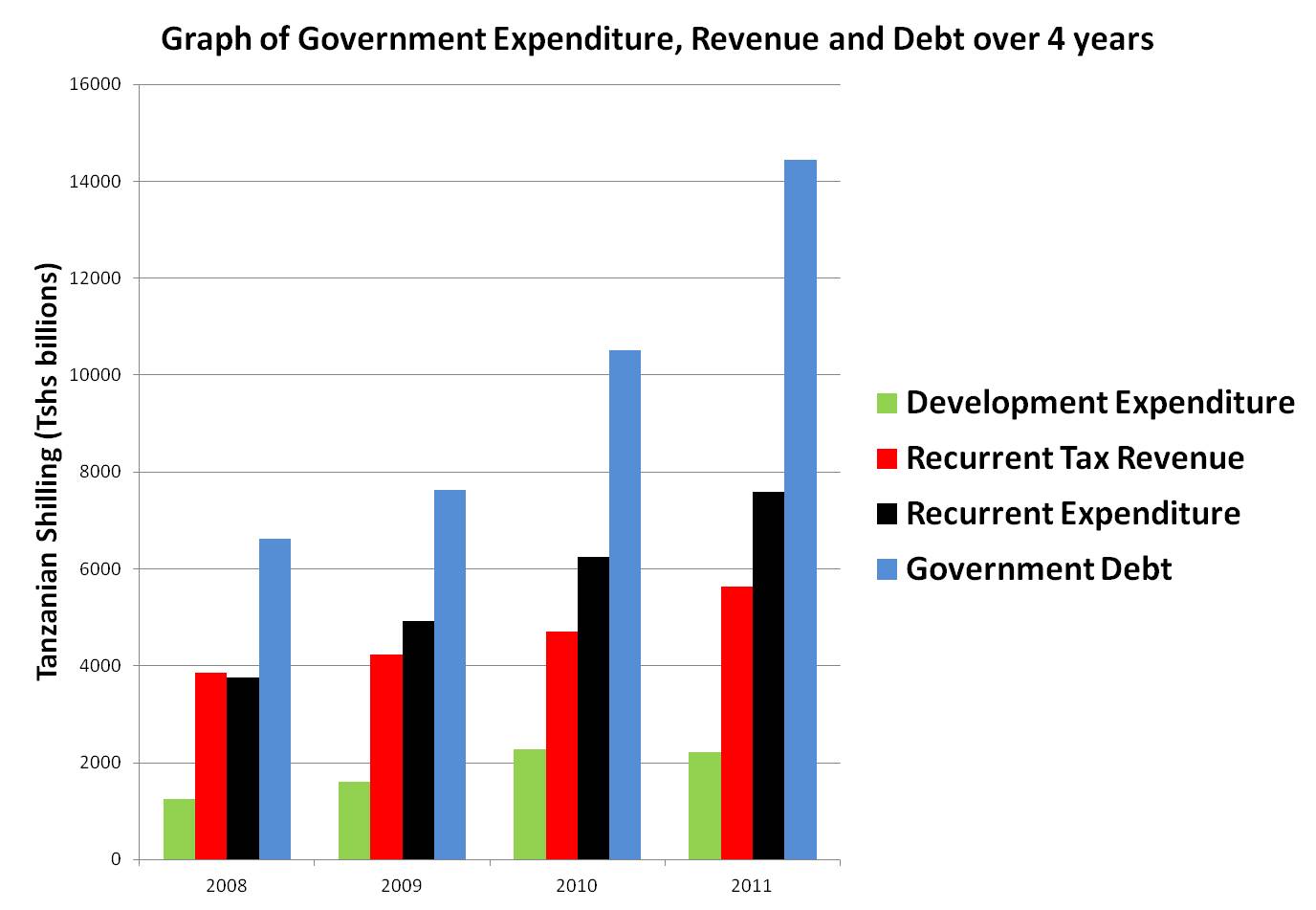
As we await the arrival of the very late but much anticipated Tanzanian budget for the year 2012/13, let us focus on a recent trend that is grabbing all the headlines. The DEBT CRISIS! Tanzania's fiscal debt has been increasing at an alarming rate recently, doubling in 3 years from 2007 where it stood at $3.4 billion dollars to June 2010 the debt increased to $6.5 billion. The debt then took only 2 years to double again to June 2012 where it is expected to above $14 billion dollars! What this means is that the debt-to-GDP ratio of 50% has now been breached and although it may still be premature to panic, the ever widening budget deficit is a cause for concern.

So is debt bad all the time? Why is the central government borrowing money to finance its operations? Lets probe this matter more objectively before jumping to conclusions. Debt and borrowing is an important driver of growth and expansion not only for governments but also for corporations, small businesses and individuals. A housing loan is a good example of how borrowing may help in overcoming a shortage of capital. Someone who wants to buy a house but doesn't have millions lying around, can take a loan from a bank to purchase the house. Then, instead of paying rent to some landlord, he/she can re-pay the loan plus interest in monthly installments after which the house becomes his/hers. Corporations do the same when buying other smaller companies or investing in fixed assets. The whole point of taking on debt is to ensure that you get a return on investment that is sufficient to cover the debt plus whatever interest is charged. That is why taking on a loan to buy clothes, to pay salaries of workers or paying for a holiday is unsustainable. 

So it seems the matter is simple? The central government can take on more debt. But only if it invests the money wisely, and on projects that will boost income a few years down the line. That is why, taking on debt for infrastructure is the norm because this will ultimately boost the country's economy by attracting more investors etc. Once the government's income rises, it will be able to pay off its debt without worrying about default. Here is where Tanzania diverts from the debt model. On the graph below (click graph to zoom in), we can see that the increase in government borrowing is far greater than the increase in development expenditure (includes infrastructure spending etc) which is almost stagnant. Most of that debt increase has been used to finance recurrent expenditure and, just as a person using his credit card to buy more clothes while unsure of how he will pay for it, this is a dangerous game to play. Other payments such as interest on accumulated debt accounts for the remainder of the increase in government debt.


Source: CAG reports (2008/09-2011/12)
At this rate, financing government debt will become unsustainable and we must come up with a solution now to avoid a debt default. A debt default will come with its own host of problems such as reduced investor confidence in Tanzania and a further pull out of foreign direct investment as well as increase in inflation as the central bank tries to increase currency flows in the country. According to current estimates, public debt will be around $14 billion by June 2012, which means we will have crossed the Debt/GDP ratio of 50%. Research by Harvard economist Ken Rogoff has shown that above levels of 60% for developing economies, growth rate is slashed on average by 2%. We need a radical change in the way government raises funds for financing its operations or else we may be headed for a debt crises of our own.